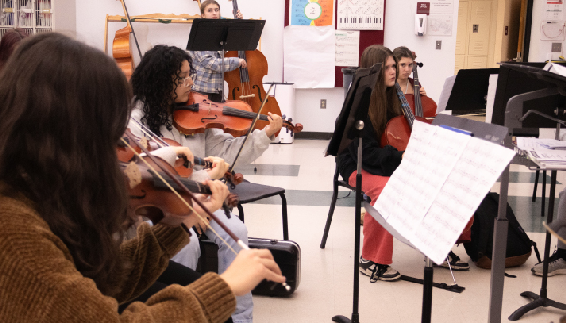
135 is the number of credits needed to graduate from West Essex High School. Of those 135, only five credits of an art class are required. This can be accomplished through a wide variety of courses such as Studio Art, Digital Photography, Orchestra and more. Since art is not considered a core class, most people view taking art as a chore to fulfill their graduation requirements. The truth is, art classes are so much more than a requirement. Once immersed in an art curriculum, skills like problem-solving and emotional expression are practiced and used to create a more well-rounded version of yourself.
In a time of intense academic competition and pressure to perform well on tests, a shift in learning topics is definitely needed throughout long school days. Impending tests and constant pages of homework take up a huge amount of energy, brainpower and time primarily in the left side of the brain, which emphasizes logic, rational thought and language perception. Spending time exercising primarily right-sided brain skills of creativity and imagination allows for the expansion of knowledge and appreciation for a whole new set of skills. One of West Essex’s own, Erica Lescota, believes art classes are foundational classes that translate into many other areas of study.
“I definitely think it’s a benefit to everyone, even if they aren’t artistically inclined,” Lescota said. “It’s kind of forgotten that art connects everything.”
Art teaches skills that many would not think relate to the class. Engaging in even an entry-level art class, such as Studio Art I, pushes students to think about the world through a lens of visual reality. What was once seen as a whole picture can be boiled down into specific parts, with the question of why things look the way they do as the main focus.
“Art classes give students the ability to creatively problem solve and a sense of autonomy,” Lescota said.
Measuring and planning also come from creative problem-solving, with dimensions and certain placements being combined to create your own visual masterpiece.
In learning music, trial and error is often a major part of creating harmony, especially when practicing with other people. Determination and teamwork are learned through this process to reach an end goal of performing the song. Miles Schmidt, a junior at West Essex, is no stranger to the music community. He believes music is a stepping stone to realizing that enjoying the process is just as important as the final result.
“Music taught me that the process, not the product, is what gives meaning to all the most formative experiences,” Schmidt said. “For instance, in a school ensemble, you rarely have more than three to four performances per year, you spend 99 percent of your time practicing and only one percent performing. The time spent practicing is really what shapes your positive memories of whatever piece you eventually perform.”
Music is also a great motivational tool because of the progression that comes with practicing a certain piece. After all the hard work put into mastering the craft and ensuring everyone is performing the right rhythms, melodies and harmonies, a huge surge of satisfaction is felt once the result is the best it could be.
“Everyone gets to listen in collective joy as beautiful music flows out,” Schmidt said. “The more you buy into whatever music class you are in, the more you look forward to each class. You will surprise yourself with how much improvement you can achieve.”
Presenting information in a visually appealing way in an advertisement can be traced back to the roots of an art class. Patience and communication when working with a team are fundamentals learned through ensemble work in a music class. Whether it is participating in a physical art class like Graphic Design or practicing vocals in Choir, art is vital for developing skills that are applicable after high school.