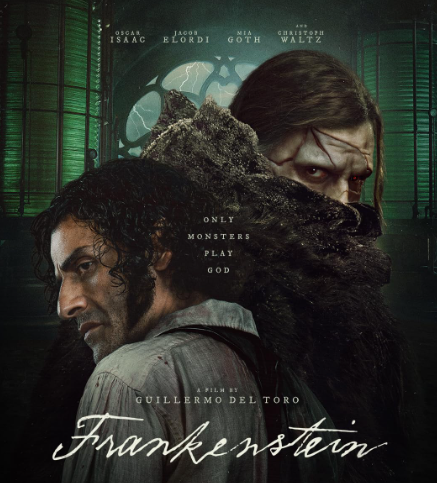
The 2025 film “Frankenstein,” directed by Guillermo del Toro, was released on Netflix on Nov. 7, bringing a bold new take on Mary Shelley’s classic novel. Starring Oscar Isaac as the obsessive scientist Victor Frankenstein and Jacob Elordi as the Creature, the movie blends gothic horror with deep themes of ambition and humanity.
Del Toro’s “Frankenstein” is a visually elaborate film that leans less into jump scares and more into emotional impacts. The cinematography is one of the film’s biggest strengths; every shot feels carefully designed, from the candle-lit labs to the icy, blue-gray landscapes. The lighting and camera work creates a dark, emotional atmosphere that fits the story without feeling too overdone. It is one of those movies where you could pause at almost any moment and it would look like a piece of art.
Both lead actors deliver strong performances. Isaac plays Victor with a mix of obsession, guilt and stubborn pride, making him feel more human than in some older adaptations of the book. Elordi’s Creature is unexpectedly emotional, and his performance makes the monster feel misunderstood rather than just some scary being. The Creature’s overall design also leans closer to Mary Shelley’s original description of pale, stuck together and more tragic than monstrous, which fans of the book seem to be appreciating.
Many die-hard readers of the novel will notice that the movie does not always stay accurate to the book. While the film does keep the basic plot, it rearranges scenes while also adding emotional moments that Shelly never wrote. In the novel, the Creature slowly learns language and morals on his own over a long period of time, but in the movie, his growth feels much quicker and more dramatic. The film also focuses more on Victor’s personal trauma, while the book spends more time questioning whether humans should push the limits of science.
However, some moments in the movie could have been much stronger. For example, the creation scene looks amazing visually, but it does not carry the same shock or horror that Shelley describes. Also, many of the very emotional scenes continuously seemed to be the most rushed moments, especially when the Creature tries to explain his feelings to those around him. Along with that, many book lovers are disappointed with the exclusion of Victor’s best friend, Henry Clerval. The movie tries to fit a lot into its runtime, and as a result, some important parts of the original story were either simplified or cut to make up for these subtle, yet impactful changes.
Still, the movie accomplishes plenty, specifically in the bond between Victor and the Creature. Their intense and heartbreaking relationship fits the film’s tone perfectly, adding to the gothic atmosphere of the story. The music and set design work together to create a world that feels mysterious and dangerous.
Overall, del Toro’s “Frankenstein” is a visually stunning and emotional adaptation that modern audiences will find engaging. It is not 100 percent accurate to Mary Shelley’s novel, but it offers a fresh and creative take on a story that has been retold for more than 200 years. While the book is still the best source for Shelley’s ideas about responsibility and creation, the film succeeds in bringing the classic tale to life in a way that is both beautiful and dramatic.