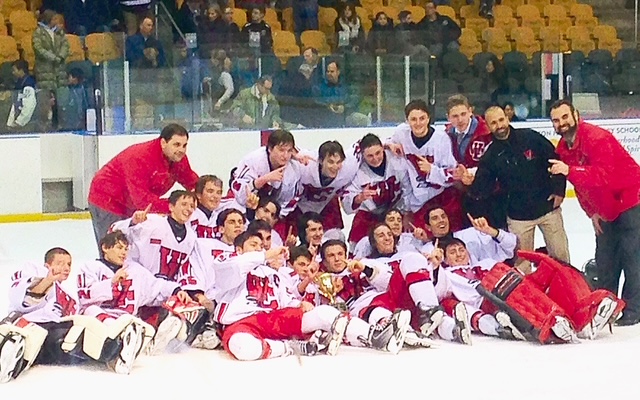
West Essex and Caldwell have always had a historic rivalry, mainly on the football field during the fall. However, when the winter season rolls around, these rivals call each other teammates. The West Essex and Caldwell hockey co-op began during the 2015-2016 season and has continued to find success every winter since then. This past season has marked a decade of playing alongside each other, highlighting not just the longevity but steady growth in both competitiveness and participation.
Coming from two different schools, the team transitioned onto the ice smoothly. Many of the players were already familiar with each other from playing as teammates or opponents on various club teams before high school. By combining students from both schools, the program is able to maintain strong roster numbers and provide a memorable experience for all students who play hockey. Head coach Marc Gregory said that combining with Caldwell has been beneficial for everyone involved, especially as interest in the program continues to grow year after year.
“It’s amazing to see the relationships that get built between players who would not normally have met each other,” Gregory said. “Two rival schools that come together for the common love of hockey.”
Despite being from different schools, the athletes set aside their rivalry and continue to unite on the ice each year, consistently building strong team chemistry. Assistant coach Tim Shea was not a member of the coaching staff for the first year of the co-op, but he experienced the growth of the program.
“It felt like this was something that had been established years ago,” Shea said. “Players had already built chemistry with each other on and off the ice, and it is something that I never really questioned and just accepted that this was how it is.”
That sense of familiarity has helped create a unified team culture, even as new players join each season.
However, combining two schools has come with several difficulties. Scheduling busing to and from the rink for practices, along with busing the Caldwell athletes to West Essex, has been a challenge. Communicating messages about practices and games between the two schools is also difficult. Differences in school schedules also make it harder to coordinate team meetings and a consistent schedule. Despite this, athletic directors from both West Essex and Caldwell work closely to provide the best experience for the hockey team.
“As far as busing goes, this is a challenge in all sports, and ice hockey is no different,” Caldwell athletic director Daniel Romano said. “I don’t think scheduling buses or games for a coop is any more difficult than scheduling for one school.”
Coaches emphasized that the logistics remain the biggest obstacle for the team, even as the team continues to find success on the ice. While there are challenges, the benefits of the co-op are far beyond the logistics.
This program not only provides players with a place to play, but it also serves as a community where athletes can come together and share their love for the sport. Players who compete against each other during the fall and spring seasons are able to build a mutual respect for one another during the winter, strengthening their relationships and the sports culture between both schools.
“We are committed to doing it for the student-athletes, and the cooperative model is the best way to ensure these students have the opportunity to get on the ice and compete,” athletic director Tim Walsh said.
Without the help of both schools, the hockey team would not be able to exist in its current form, let alone grow into a competitive and well-established program. As the program enters its second decade, the same sense of unity still lingers from early seasons and continues to define what started as a simple solution but has become a huge success.
“I’m glad we were able to give the Caldwell players a place to play, and that West Essex was so welcoming of it,” Gregory said.