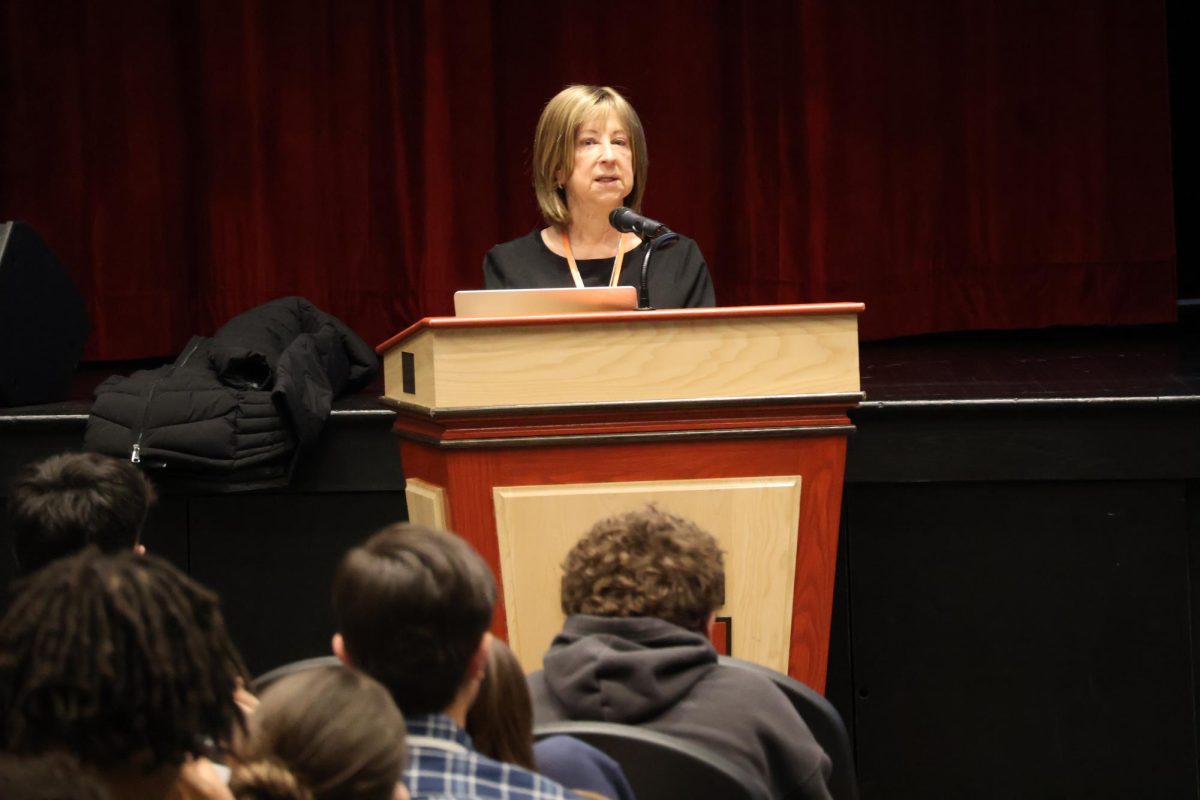
On Feb. 5, Dr. Fran Levin, a member of Second Generation of New Jersey (2GNJ), visited West Essex High School to educate students and staff about the Holocaust and its impact on her family’s story. 2GNJ, an organization that consists of family and friends of Holocaust survivors, aims to enhance awareness of the holocaust through educational presentations to promote a positive change in society.
The goal of this program is to promote and acknowledge what happened in the past while also making sure to honor the memory of the victims. Levin, the daughter of two Holocaust survivors, uses 2GNJ to highlight her parents’ experiences and to educate others about the drastic impact the Holocaust had on so many people. After learning what her parents went through, Levin found the courage to share their story, emphasizing that the Holocaust did not start at the concentration camps, but way before, with the power of words.
Before the war, Levin explained that both her mother and father lived a normal life. Levin’s mother grew up in Lodz, Poland, and her father grew up in Lublin, Poland. He worked at his family’s lumber mill. Before the Holocaust, both survivors had separate marriages and children.
As anti-semitic rhetoric grew in Europe, tragedy struck Levin’s mother. Nazi soldiers killed her first husband. She then tried to go back to her homeland with her son, Elion, but as they went through the concentration camp, they saw Elion under her coat and shot him. Levin described her mother as one of the strongest women she knows, and how she tries to take after her because she had no choice but to move forward if she had any hope of staying alive herself.
Unlike Levin’s mother, he was assigned a different task while spending his time in concentration camps. His knowledge of seven languages enabled him to translate crucial documents for the Nazi Soldiers. Leveraging his positions and limited power, he aided numerous suffering individuals and maintained communication with the outside world. Levin’s father altered document information to obstruct the Nazi’s plans while also connecting with the Resistance, a group fighting against the Nazis. By leaking plans to those outside the camps, he helped their efforts, ultimately demonstrating that altering and leaking these documents was key to their resistance.
After many grueling years, the collapse of the Nazis and the liberation of concentration camps marked the end of the Holocaust. Levin’s parents became survivors, but more struggles were yet to come. Many survivors were practically homeless and resorted to displacement camps. Levin’s mother was often turned away because of the. Eventually, after refusing to back down, a displacement camp accepted her. Upon her arrival, she crossed paths with a man, who later became her husband and Levin’s father.
“He took one look at her, and he said, ‘There is room for her here, and he spent six months chasing her until finally she fell in love with him,” Levin said.
At the displacement camp, Levin’s parents got married and later had a son. During this time, Levin’s mother was still unsure if any of her family had survived the war. She placed several newspaper ads with her brother’s name, hoping he would see. Eventually, her mother found her brother with the help of a friend.
“After everything my mother had been through, she said it was like the happiest moment of her life,” Dr. Levin said.
Soon after, her parents moved to New Jersey to begin a new chapter. Though still experiencing grief and trauma, her parents strived to provide a healthy and stable life for their children. Levin believes that by taking action, she can use her parents’ history as a tool to enlighten her audiences and future generations.
“When we listen to Holocaust survivors’ stories, we’re not just listening and learning about history, we’re being trusted with memories,” Levin said.
Levin’s goal is not to upset people, but to inspire them to take action. She believes that our generation can control what happens to our future and to prevent something similar to the Holocaust from ever happening.
“I am sharing this story with you because I think that your generation will decide what happens to history, whether its lessons and whether you choose to speak up when you see injustice,” Levin said.