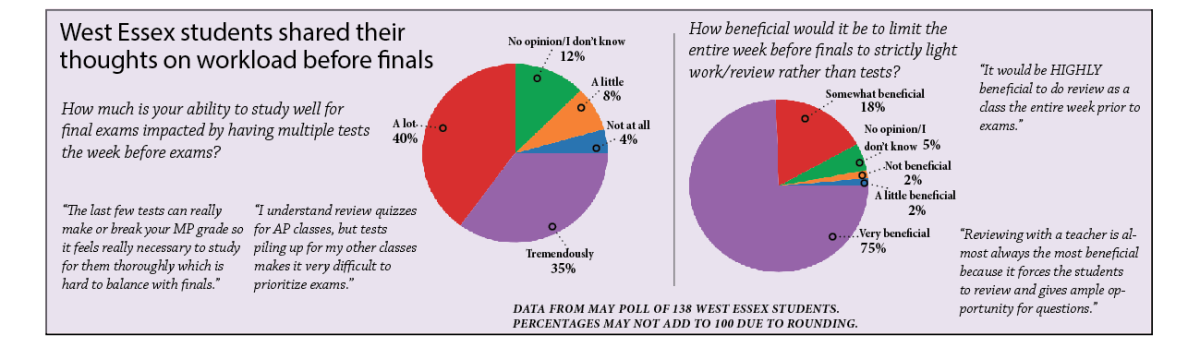
Stress from tests? You’re not alone. With so little time to prepare, many students have been feeling far more bombarded by the number of tests they’ve been given. Going into tests less confident than they’d like and coming out with a failing grade is something no one wants to experience, and yet, for many, it’s become the norm.
Typically, towards the end of each marking period, all teachers end up piling unnecessary amounts of summatives on students, causing stress levels to rise alarmingly quickly. Students are unable to reach their full potential on these tests, which decreases the grade they will ultimately receive. To address this unfortunate situation, teachers should take students’ schedules into account when assigning the end-of-marking-period tests.
Several sophomore students said that having so many tests in a single school day is difficult because they feel they do not have enough time to study for each assessment. Everyone could understand that it is deemed impossible to remember a ton of information for different subjects at the same time. With many tests crammed into one week, students can’t help but scramble, trying to remember everything for all their subjects. Because of this, students should have only one or two tests per day. With more time to study for each subject, test scores will increase while stress levels decrease. If the school has a limit on the number of tests a student can take per day, they wouldn’t have to cram all their studying into one night, which many do.
At the end of the last marking period, students felt overworked and stressed out because many had around four tests a day for multiple days. Studying for each test in one night is incredibly stressful. Also, spending only an hour on each topic may not be enough for students to prepare. However, wanting to study for multiple hours per subject in one night is often impossible, as students also have other responsibilities, such as sports, chores or even a job.
To combat these issues, limiting students to only one or two tests per day would give them more time to focus on each subject and decrease stress. Also, this would still allow teachers to assign their tests around the same time frame they had originally planned. Instead of having eight tests in two days, teachers would give them over three or four days. Teachers would have more time to grade these tests, and students would have more time to study for these tests.
This problem not only affects West Essex students but also others across the U.S., as some schools already have policies addressing it. This problem doesn’t have a universal solution because schools across the U.S. are run differently with their own scheduling and policies; however, if West Essex creates a policy that solves this issue, not only would students benefit, but the administration would as well.